Carbon Project Land Sales Put Farm Insurance Reviews in Focus
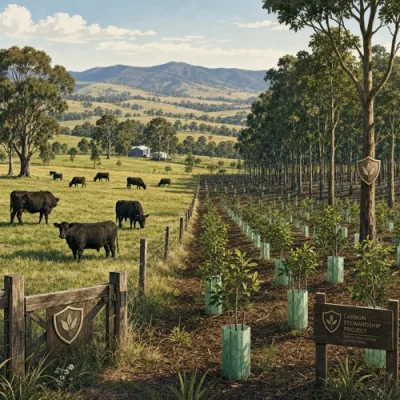
Tree planting, carbon credits and mixed land use can change the risk profile of rural properties
3
The information on this website is general in nature and does not take into account your objectives, financial situation, or needs. Consider seeking personal advice from a licensed adviser before acting on any information.
ABC Rural’s 21 November 2026 report on the sale of Rushy Lagoon in north-east Tasmania and Cobungra Station in Victoria’s high country has put large-scale carbon projects back in the rural spotlight.
The two properties, together covering more than 50,000 hectares, are being repositioned for tree planting and carbon-related ventures after sales finalised in August.
For farm businesses watching the trend, the insurance lesson is broader than carbon: when land use changes, the risk profile of the property can change with it.
The issue is not that carbon farming is automatically riskier than grazing or cropping. It is that changing part of a working property from livestock, cropping or mixed farming into forestry, environmental planting or carbon sequestration can alter what is exposed to loss. Fire behaviour, access tracks, fencing, pest and weed controls, contractor activity, machinery movements and neighbouring-property interfaces may all look different after a project begins.
That matters for commercial farm insurance because policies are usually built around declared activities, assets, locations and sums insured. A paddock used for grazing may carry a different practical exposure from a planted carbon area with young trees, spraying work, firebreak maintenance, access restrictions or third-party project partners. If those changes are not reflected in policy schedules, disclosure answers or risk information, a future claim may become more complicated than expected.
Farm operators considering carbon income may wish to work through several general questions before planting or signing a project agreement:
whether the insurer or broker has been told about the proposed land-use change;
whether new fencing, tracks, water infrastructure, sheds, machinery or technology should be included in asset records;
whether public liability, contractor liability and visitor access exposures have changed;
whether fire management plans, access points and emergency water sources are clearly documented;
whether carbon credit income, restoration costs or contractual penalties are excluded from ordinary farm cover.
There is also an important distinction between insuring physical assets and managing carbon scheme obligations. Under the Australian Carbon Credit Unit framework, sequestration projects can carry long permanence obligations and ongoing monitoring requirements if stored carbon is later affected by events such as fire, flood, pest attack or poor management. Standard farm policies may respond to insured damage to listed property, but they should not be assumed to cover carbon credit losses, regulatory obligations or contractual liabilities unless the wording clearly says so.
For neighbouring producers, large plantings may raise practical questions about fire spread, weed pressure, pests and access across district roads or shared boundaries. Project proponents in the ABC report argued that carbon and forestry projects can involve active management of fire, weeds and pests. Even so, the insurance takeaway is simple: major operational changes should trigger early record updates, policy wording checks and careful discussion before the next renewal, not after a loss has occurred.
Please Note: We do not endorse any specific products or companies. Some content is sourced from third parties, including press releases, and may not be independently verified for accuracy or completeness.
Australians are increasingly turning to artificial intelligence and digital tools for help with life insurance questions, according to a new warning from the Council of Australian Life Insurers. For business owners considering key person cover, the development is a reminder that fast answers can be useful for general orientation, but they are no substitute for understanding policy definitions, ownership, tax purpose and claims triggers before decisions are made. - read more
A new Life Code Compliance Committee sanction should catch the attention of Australian business owners who rely on life insurance to support succession, debt protection or key person planning. Published on 16 November 2026, the de-identified case involved an insurer being formally warned after about $1.6 million, including interest, was underpaid across 66 income protection and death benefit claims. - read more
A fresh warning from the National Heavy Vehicle Regulator about speed limiter tampering is a timely reminder that heavy vehicle compliance is also an insurance evidence issue. The regulator’s November update followed the interception of a heavy vehicle with its speed limiter set to 127km/h, despite earlier national enforcement aimed at speeding and limiter interference. - read more
A recent Australian Financial Complaints Authority decision has put fresh attention on a practical issue for income insurance customers: answering health questions is not always as simple as recalling a diagnosis. The case, reported on 23 November 2026, involved an income protection policyholder whose mental health disclosure became central to a later claim dispute. - read more
The National Heavy Vehicle Regulator’s launch of Operation Respite on 25 November 2026 gives Australian truck operators a timely reminder that peak-season pressure is also an insurance risk issue. The joint NHVR and police operation is targeting heavy vehicle driver fatigue as Christmas freight volumes rise and more holiday motorists share the road. - read more
For many millennials, navigating the complexities of personal finance and future planning can feel like a bewildering journey. Among these financial responsibilities, life insurance emerges as a paramount consideration. More than just a safety net, life insurance can be the cornerstone of a sound financial strategy, providing peace of mind for both the policyholder and their loved ones. - read more
Life insurance is a fundamental component of a robust financial plan, yet its significance is often underestimated. It serves as a safety net, ensuring that your loved ones are financially secure in the event of your absence. Understanding life insurance is the first step towards safeguarding your family’s future. - read more
Life insurance in Australia is supported by consumer protections covering disclosure documents, product design, cooling-off rights, claims handling, complaints and external dispute resolution. - read more
Life insurance can help provide a financial safety net for the people who depend on you. The right cover amount is not a single fixed figure: it depends on your income, debts, family responsibilities, future goals, savings and the type of policy you choose. - read more
Life insurance is an essential safety net for families, providing financial security when it's needed the most. As your family grows, the importance of having a well-structured life insurance policy becomes even more critical. In the busy lives we lead today, it’s easy to overlook this crucial aspect of financial planning. However, ensuring your coverage meets your family's evolving needs is vital. - read more
Start Here !
Apply now for your free Insurance assessment and price comparisons!
Knowledgebase
Rider: An optional provision added to an insurance policy that provides additional benefits or coverage.




No comments yet. Be the first to share your thoughts.